

A sudden accident can leave a family facing grief and immediate financial uncertainty at the same time. For employees covered through their workplace, the accidental death benefit can provide financial support when a covered accident leads to death.
The benefit is designed to help the family manage household responsibilities, ongoing commitments and other essential needs.
Understanding who receives the payment, how the amount is decided and what documents are required can make the claim process clearer during a difficult period.
Top Accidental Death Benefits
Eligible Nominee Receives the Benefit
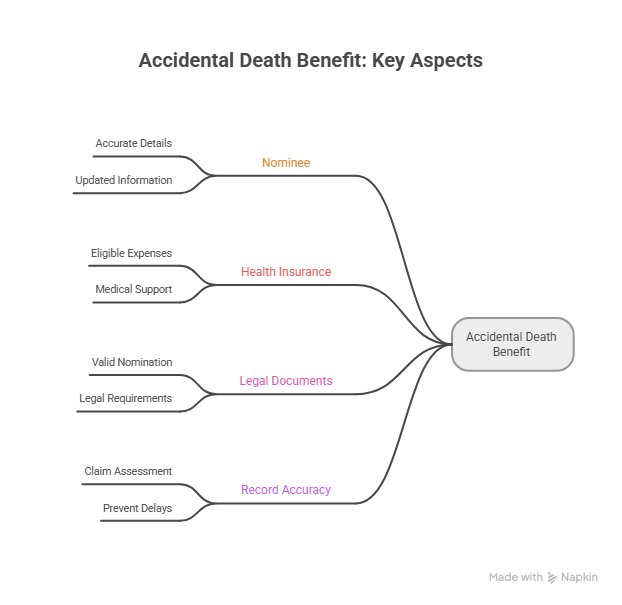
The nominee recorded under the employee’s cover receives the accidental death benefit. While health insurance plans support eligible medical expenses, this benefit provides financial compensation after a covered accidental death.
- Nominee details should remain accurate and updated.
- Legal documents may be needed without a valid nomination.
Correct records can help prevent delays during claim assessment.
Lump Sum Compensation on Accidental Death
Under group personal accident insurance, the accidental death benefit is paid as a lump sum. Unlike hospital reimbursement, it is linked to the covered event and amount shown in the policy schedule.
- It is usually paid as a single benefit.
- Policy terms determine eligibility.
The family may use the amount for pressing immediate financial priorities.
Death Must Result from a Covered Accident
The death must arise directly from an accident within the policy’s scope. Insurers review the circumstances, medical findings and official records to determine whether the event meets the stated definition.
- The accident should occur during active coverage.
- The death must meet relevant claim conditions.
Employees should check the certificate and policy wording for applicable requirements.
Coverage Amount Depends on the Sum Insured
The payable benefit depends on the sum insured assigned to the employee. Employers may provide uniform cover or link the amount to designation, salary or employment category.
- The schedule states the applicable sum insured.
- Payment remains subject to policy limits and conditions.
Employees should review their details instead of assuming every workplace offers identical coverage.
Natural Death Is Not Covered
Personal accident cover applies to accidental events, not death caused by illness, ageing or natural medical conditions. Those cases may fall under other employee benefits, depending on the cover arranged.
- The cause of death is carefully reviewed.
- Medical and official records support the assessment.
This distinction helps families approach the appropriate policy for a claim.
Policy Exclusions Can Affect the Claim
Even when an accident has occurred, the claim is assessed against exclusions and conditions stated in the contract. Certain circumstances, activities or conduct may fall outside the agreed scope.
- Exclusions differ across policy wordings.
- Employer-specific endorsements may also apply.
Reading the schedule, certificate and policy wording together gives a clearer view of the available protection.
Read More: Why Frequent Flyers Need a Different Travel Insurance Approach
Claim Requires Valid Supporting Documents
A death claim needs documents that establish the employee’s identity, coverage, cause of death and nominee entitlement. The list depends on the incident and claims process.
- Common records include the claim form and death certificate.
- Accident-related reports may be requested where relevant.
The nominee should inform the employer or insurer promptly and submit complete records.
Financial Security for the Employee’s Family
The benefit can offer a financial cushion when the family loses the employee’s income unexpectedly. It may help manage household spending, education needs, commitments or the move towards a revised financial plan.
- The payment can support immediate responsibilities.
- It may protect savings from sudden pressure.
Timely support can bring stability during a deeply difficult period.
Conclusion
Accidental death benefit under workplace accident cover provides structured financial assistance to an employee’s family after a covered event. Its value depends on the recorded sum insured, valid nomination, cause of death, policy conditions and supporting documents.
Employees should understand their certificate of insurance and keep nominee details current. Families should also contact the employer or insurer promptly after an incident, as claim requirements and timelines can vary across policies.