
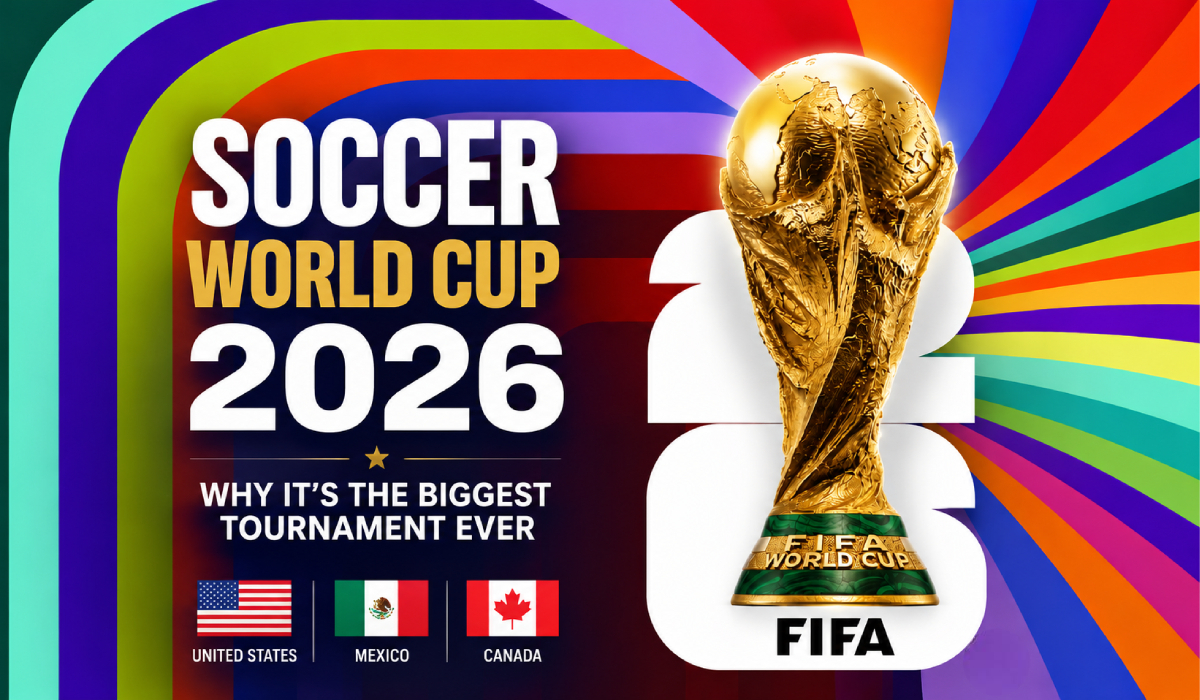
The Soccer World Cup 2026 isn’t just another edition of the most-watched tournament in the world; it’s a real change in what a World Cup can be. More teams, more matches, more host cities, more countries, more fans, and more money are flowing through this tournament than any World Cup before it. Here’s exactly what makes the 2026 FIFA World Cup historic, told through the numbers and records that define it.
Why Is Soccer World Cup 2026 the Biggest Tournament in Football History?
Every measurable dimension of the World Cup got bigger for 2026. The number of teams went from 32 to 48, which is a 50% rise. The match count rose from 64 to 104. The tournament expanded from one host nation to three. And the projected economic footprint dwarfs anything football has produced before, with independent analysts estimating the event will generate somewhere between $40 billion and $80 billion in global economic activity, depending on the methodology used.
Simply put, this is the biggest World Cup ever, in terms of participation, geography, length, and the amount of money it involves.
Which Countries Are Hosting World Cup 2026?
The United States, Mexico, and Canada are all hosting the 2026 FIFA World Cup together. This is the first time in the tournament’s history that three countries have done this. It’s also only the second time multiple countries have co-hosted at all, following Japan and South Korea’s joint hosting in 2002.
Mexico becomes the first country ever to host or co-host the World Cup three times, having previously staged the tournament in 1970 and 1986. The United States previously hosted in 1994, and this marks Canada’s first time as a World Cup host nation.
How Many Teams Will Participate in FIFA World Cup 2026?
48 teams, up from 32 teams at every World Cup since 1998 in France. This is the largest field in the tournament’s 96-year history, and it’s also the first World Cup where all six FIFA confederations (UEFA, CONMEBOL, CAF, AFC, CONCACAF, and OFC) have guaranteed qualification berths.
How Many Matches Will Be Played in World Cup 2026?
In total, 104 games will be played, with 72 in the group stage and 32 in the knockout rounds. This is up from 64 games in the previous 32-team format, which was used at Qatar 2022 and all tournaments before it. That’s a 40-match increase, spread across 39 days, compared to the roughly 32-day length of recent World Cups.
Which Stadium Will Host the World Cup 2026 Final?
The final is set for July 19, 2026, at New York New Jersey Stadium, which is the World Cup name for MetLife Stadium in East Rutherford, New Jersey. The stadium was renamed for the tournament to follow FIFA’s rules on sponsorship and naming. The stadium will host the final in front of a capacity crowd of 82,500, making it one of the largest World Cup final attendances in the tournament’s history.
How Many Host Cities Are There in World Cup 2026?
16 host cities across three countries are staging matches:
- United States (11 cities): Atlanta, Boston, Dallas, Houston, Kansas City, Los Angeles, Miami, New York/New Jersey, Philadelphia, San Francisco Bay Area, and Seattle
- Mexico (3 cities): Mexico City, Guadalajara, and Monterrey
- Canada (2 cities): Toronto and Vancouver
The United States carries the heaviest hosting load by far, staging 78 of the tournament’s 104 matches, while Mexico and Canada combine for the remaining 26.
Which City Will Host the Opening Match of World Cup 2026?
The first game of the tournament took place in Mexico City on June 11, 2026, at the historic Estadio Azteca. Co-host Mexico played South Africa in a rematch of the first game of the 2010 World Cup, which also featured these two countries. It’s a fitting symbolic start, since Mexico City’s Azteca Stadium becomes the first venue ever to host matches across three different World Cups (1970, 1986, and 2026).
What Is the Expected Attendance for World Cup 2026?
Tourism Economics and other independent analysts project the tournament will draw approximately 6.5 million total attendees, including roughly 2.6 million international visitors to North America over the six-week event. Separate U.S.-focused projections estimate around 1.24 million international visitors specifically for the U.S. leg of the tournament, with international travelers expected to stay an average of about 12 days and attend roughly two matches each.
It’s worth noting that actual attendance and turnout have become a live talking point during the tournament itself, with reporting on high ticket prices, visa and travel-entry friction for fans from some countries, and uneven hotel-booking trends across host cities. The numbers that FIFA predicted before the tournament and the ones that are being reported as the games are played haven’t matched up exactly. That’s just how a tournament of this size works in real life.
Why Are Three Countries Hosting World Cup 2026?
FIFA’s decision to award hosting jointly to the United States, Mexico, and Canada (the “United 2026” bid, which beat a rival bid from Morocco) was driven largely by the tournament’s own expansion. Once FIFA decided to increase the number of teams from 32 to 48 and the number of games to 104, it became clear that no single country’s stadiums and other infrastructure could handle such a large tournament. Spreading the load across three nations distributes the financial, logistical, and infrastructure pressure that a 48-team World Cup creates, while also letting FIFA tap into three different fan bases, broadcast markets, and tourism economies simultaneously.
What Records Could World Cup 2026 Break?
Several records are essentially guaranteed, and others are live possibilities as the tournament unfolds:
- Most teams ever: 48, surpassing every previous edition.
- Most matches ever: 104, easily the most in tournament history.
- First three-nation host: Never done before in World Cup history.
- Longest World Cup ever: 39 days, longer than any previous edition.
- Largest global economic impact of any sporting event: Independent estimates ranging from $40 billion to $80 billion in economic activity would make this the most economically impactful sporting event ever held, surpassing previous World Cups and other mega-events.
- Record prize money: The champion will receive $50 million in prize money, up from $42 million at Qatar 2022.
- Highest disclosed single-ticket sale: Resale reporting has already noted a front-row seat selling for $32,000, among the most expensive World Cup tickets ever recorded.
- Most valuable commercial cycle for FIFA: FIFA projects revenues exceeding $11–13 billion for the 2023–2026 commercial cycle, a new high for the organization.
Whether attendance figures and tourism spending ultimately hit FIFA’s original projections is one of the open questions analysts are still tracking in real time as the tournament plays out.
How Can Fans Buy World Cup 2026 Tickets?
The official and safest source for World Cup 2026 tickets is FIFA.com/tickets. As of the tournament’s final sales window, FIFA’s Last-Minute Sales Phase remains open and runs through the end of the tournament, alongside the FIFA Resale/Exchange Marketplace for tickets originally purchased through official channels.
A few practical points for fans buying now that the tournament is underway:
- Official resale: The FIFA Resale/Exchange Marketplace (for the U.S., Canada, and international buyers) and the separate Mexican Exchange Marketplace (face-value only, by law) are the only FIFA-sanctioned resale channels. Listings can be sporadic, so checking frequently and acting quickly matters.
- Fees: FIFA’s official resale marketplace charges buyers and sellers about 15% of the ticket price as fees. This means that fees can make up to 30% of the ticket price.
- Third-party resale: Sites like StubHub, SeatGeek, SeatPick, Gametime, and VividSeats also list World Cup tickets, generally with buyer-protection guarantees, but prices can run well above face value, especially for marquee matches and the final.
- There are no printed or emailed tickets, and screenshots won’t work at the gate. Instead, every World Cup 2026 ticket is sent digitally through the official FWC26 Mobile Tickets app.
- Watch for fraud: U.S. authorities have flagged a wave of fake ticket sites mimicking FIFA’s branding. The only safe purchase path is FIFA.com/tickets directly, or a licensed resale partner that transfers the ticket into your official FIFA account.
The Bigger Picture
The 2026 World Cup was historic in more ways than one. Almost every aspect of the tournament changed at the same time. More teams created more matches, which demanded more host cities, which required more countries to share the load, which in turn created a tourism and economic event larger than any World Cup (and arguably any sporting event) before it. Even if not every prediction FIFA made comes true, the sheer size of the event will make the 2026 World Cup a real turning point in football history, the first time the tournament was held in more than one country.