
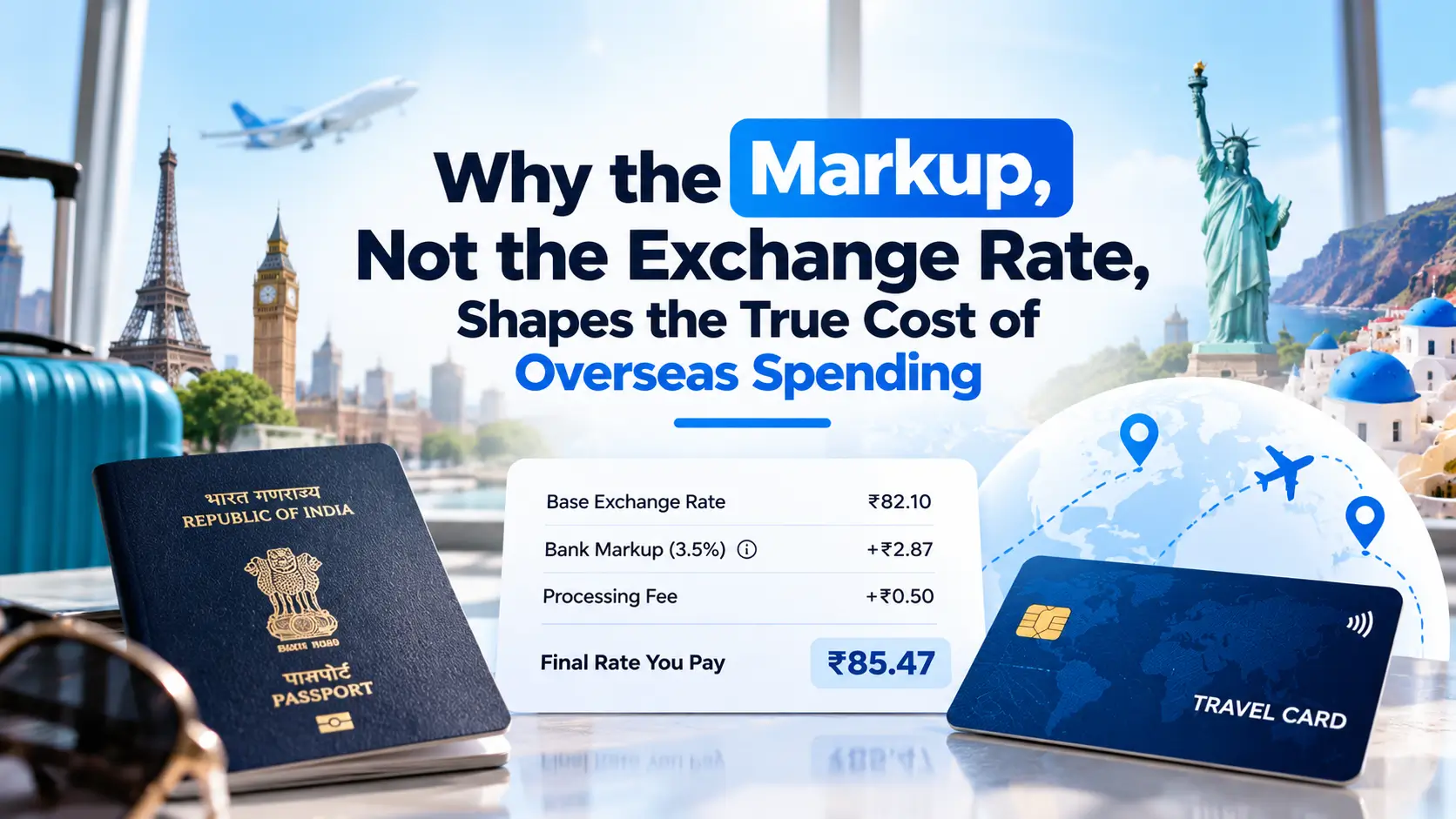
Travellers tend to watch the exchange rate closely. They check it before booking, compare it across counters and follow its movement from day to day. Yet the rate shown on a screen is rarely the rate applied to a card swipe.
Between the two is a charge that gets far less scrutiny: the forex markup. A zero markup forex card addresses this layer of cost directly, and understanding how that layer works helps a traveller budget with more accuracy.
What the Markup Actually Is
The mid-market rate is the reference rate at which currencies trade between banks. Most card issuers do not pass this rate on unchanged; they add a percentage over it, and that percentage is the markup. Because it is built into the applied rate rather than listed as a separate fee, many cardholders never see it as a line on the statement.
A single overseas transaction can also carry more than one layer of charge, and the table below separates them.
| Cost Layer | What It Means | Where It Appears |
| Mid-market rate | The reference rate for the currency pair | Underlying conversion |
| Forex markup | A percentage added over the reference rate | Embedded in the applied rate |
| Cross-currency conversion charge | A fee when a payment is converted between currencies | Statement or applied rate |
| ATM withdrawal fee | A fee for cash withdrawals abroad | Separate line item |
Reading a card’s terms against this list shows which layers the issuer actually charges. That is a more useful exercise than comparing headline exchange rates alone.
The Arithmetic That Is Often Overlooked
A markup of three or four per cent sounds minor in isolation. Applied to a full trip budget, it becomes a meaningful sum.
Note: The figures below are illustrative. They assume a rate of ₹85 per US dollar and a markup of 3.5 per cent.
| Overseas Spend (INR equivalent) | Markup Cost at 3.5% | Markup Cost at Zero Markup |
| ₹1,00,000 | ₹3,500 | ₹0 |
| ₹2,50,000 | ₹8,750 | ₹0 |
| ₹5,00,000 | ₹17,500 | ₹0 |
A family spending ₹2,50,000 on accommodation, dining and local transport would pay ₹8,750 purely as markup. That amount could cover a good part of a few nights’ stay.
The point is not that every trip involves such figures. The point is that the charge scales with spending, so it deserves attention in proportion to the budget.
Why a Single-Currency Structure is Needed
The Thomas Cook One Currency Card is a prepaid travel card loaded in US dollars. When a payment is made in another currency, the required amount is converted from the dollar balance.
The card carries zero forex markup and zero cross-currency conversion charges on eligible transactions, which is the basis of its positioning as a zero markup forex card.
The structure has a practical consequence for multi-country itineraries. A traveller moving through several destinations does not need to load a separate currency wallet for each one. A single balance serves the whole journey. The main features are set out below.
- The card is loaded in US dollars, and eligible payments in other currencies are converted from that balance.
- Works at eligible Mastercard merchants and supported international ATMs.
- Covers shopping, dining, accommodation and other permitted expenses.
- It is valid for five years from purchase, subject to the applicable card terms.
- Can be reloaded through supported channels when the balance runs low.
The five-year validity is worth noting separately. A travel card that lasts several years can be reloaded for each trip, so the traveller does not have to apply for a new one every time.
Questions Worth Asking Before Choosing a Card
Not every card marketed as low-cost removes every charge. A careful reader should confirm the following points in the terms before loading any funds.
- Is the markup stated as zero, and does that apply to all transactions or only eligible ones?
- Are cross-currency conversion charges also waived, or only the markup?
- What fees apply to ATM withdrawals, reloads and card issuance?
- What is the validity period, and how is the card reloaded?
- Does the loaded currency suit the destinations on the itinerary?
The second question matters most. A card may advertise no markup while still applying a separate conversion charge when the transaction currency differs from the card currency. The two are different costs, and a traveller should check that both are addressed.
A Closing Note
The exchange rate draws most of the attention, but the markup applied over it often decides what a trip costs in the end. A zero markup forex card removes one of those layers, and a single-currency structure like the one above reduces the effort of managing several wallets. Neither feature replaces a close reading of the terms. A traveller who separates the layers of cost, tests each against the card’s conditions and plans the loading amount with care is likely to find that the final figure matches the budget more closely.


